
Above the pot, an overwatered orchid often looks thirsty: limp, wrinkled or yellowing leaves. The proof is in the pot. Roots are brown or black, soft and mushy, or hollow, usually sitting in soggy, broken-down mix.
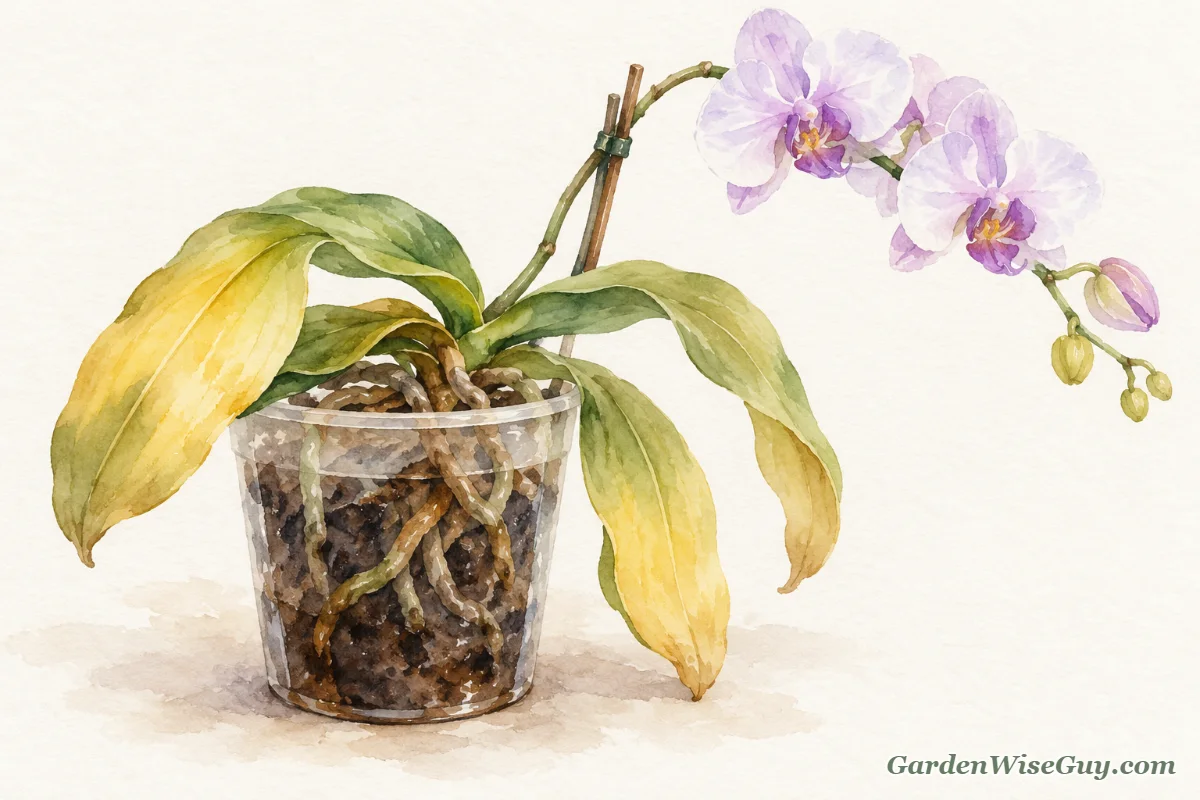
Can orchids really be overwatered?
Yes, and it is one of the most common ways orchids die. The problem usually isn’t how much water you pour in at once. It is mix that stays wet too long, because the plant is watered again before it has dried. Wet mix shuts out air, roots die, and rot follows. With few working roots, the plant can’t move water to its leaves, so it wilts in wet mix, and many people respond by watering more.
What to look for
- Roots: soft, mushy or hollow. Squeeze one; if the outer layer slides off and leaves a thin string, that root is dead. Firm brown roots that stay wet are on their way.
- Mix: dark, fine and compacted, still damp days after watering. It may smell sour.
- Leaves: limp, wrinkled or yellowing; new leaves smaller than the last ones.
- Base of the plant: browning that starts at the base of the stem or pseudobulbs usually means rot has spread from the roots.
It isn’t always “too much water”
Several problems lead to the same rotted roots, and the fix depends on which one you have:
| Problem | What’s going on | How to spot it |
|---|---|---|
| Watering too often | The pot is watered before the mix has dried | The mix is still damp when you water |
| Poor drainage | Water can’t escape the pot | No drainage holes, or a saucer or decorative pot holding water |
| Broken-down mix | Bark or moss has decayed into fine, soggy material, usually after one to three years | The mix looks like soil and stays wet for days |
| Slow drying | The pot dries slowly because of cool temperatures, low light or still air | A schedule that worked in summer leaves the pot wet in winter |
Root rot is the result of these, not a separate cause.
Not every dark root is rotten
Healthy roots are usually white or silvery with green growing tips. Firm black or brown roots can simply be old, or a sign of very dry air. Black tips on otherwise healthy roots often point to salt buildup from fertilizer or hard water. Squeeze before you cut.
What to do
- Slide the plant out of its pot and look at every root.
- Cut away soft, hollow roots with scissors cleaned between cuts.
- Repot in fresh, coarse orchid mix, in a pot just big enough for the healthy roots that remain. Make sure it drains.
- Water only when the new mix is close to dry, and give the plant time to grow new roots.
Common mistake
Seeing limp leaves and watering more.
Sources
- Phalaenopsis, NC State Extension
- Orchids (HGIC 1560), Clemson Cooperative Extension
- Root and Pseudobulb Problems, American Orchid Society
- Leaf Problems, American Orchid Society
- Bulb, Stem and Root Rots, American Orchid Society
- Phalaenopsis Culture Sheet, American Orchid Society
- Air Movement, American Orchid Society