
An underwatered orchid has limp, leathery or wrinkled leaves, shriveled pseudobulbs if it has them, and roots that are thin, papery and grayish-silver. On thin-leaved orchids such as Oncidium and Miltoniopsis, new leaves may come out pleated like an accordion.
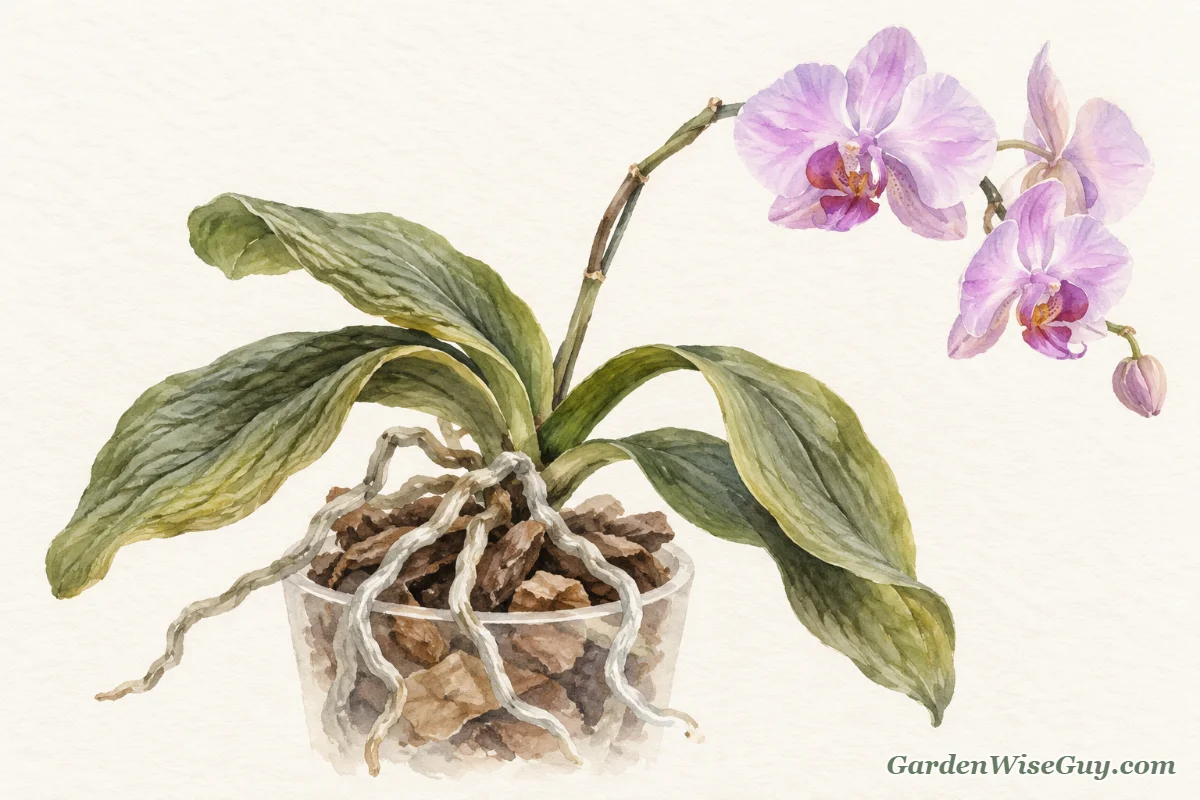
Why you need to check the roots
The leaves look almost the same on an overwatered orchid, because in both cases water isn’t reaching them. The roots tell the difference. Dry roots are firm but shriveled; rotted roots are soft and mushy.
What to look for
- Roots: firm but thin and shriveled, pale silver-gray, never soft.
- Mix: dry and light; it may have pulled away from the side of the pot.
- Leaves and pseudobulbs: fine wrinkles, limpness; flowers and buds may drop early.
What to do
- Confirm the roots are firm, not rotted.
- Water thoroughly. If the mix is so dry that water runs straight through, let the pot sit in water for a few minutes, then drain it completely.
- Check the pot sooner from now on, and water when it is close to dry.
- If the pot dries within a day or two, try a plastic pot or a mix that holds a little more moisture.
Some orchids with pseudobulbs are kept a little drier in winter, and slight wrinkling then can be normal. Deep wrinkles with thinning bulbs are not.
Common mistake
Calling every wrinkled leaf thirst without checking the roots.
Sources
- Phalaenopsis, NC State Extension
- Watering Orchids, American Orchid Society
- Root and Pseudobulb Problems, American Orchid Society
- Leaf Problems, American Orchid Society
- Winter Orchid Care, American Orchid Society