
Most orchids sold as houseplants want bright light without hot, direct midday sun. Moth orchids (Phalaenopsis) and slipper orchids (Paphiopedilum) need the least light; Cattleya, Dendrobium and Oncidium need noticeably more. Indoors, that usually means a spot right by a bright window, not across the room.
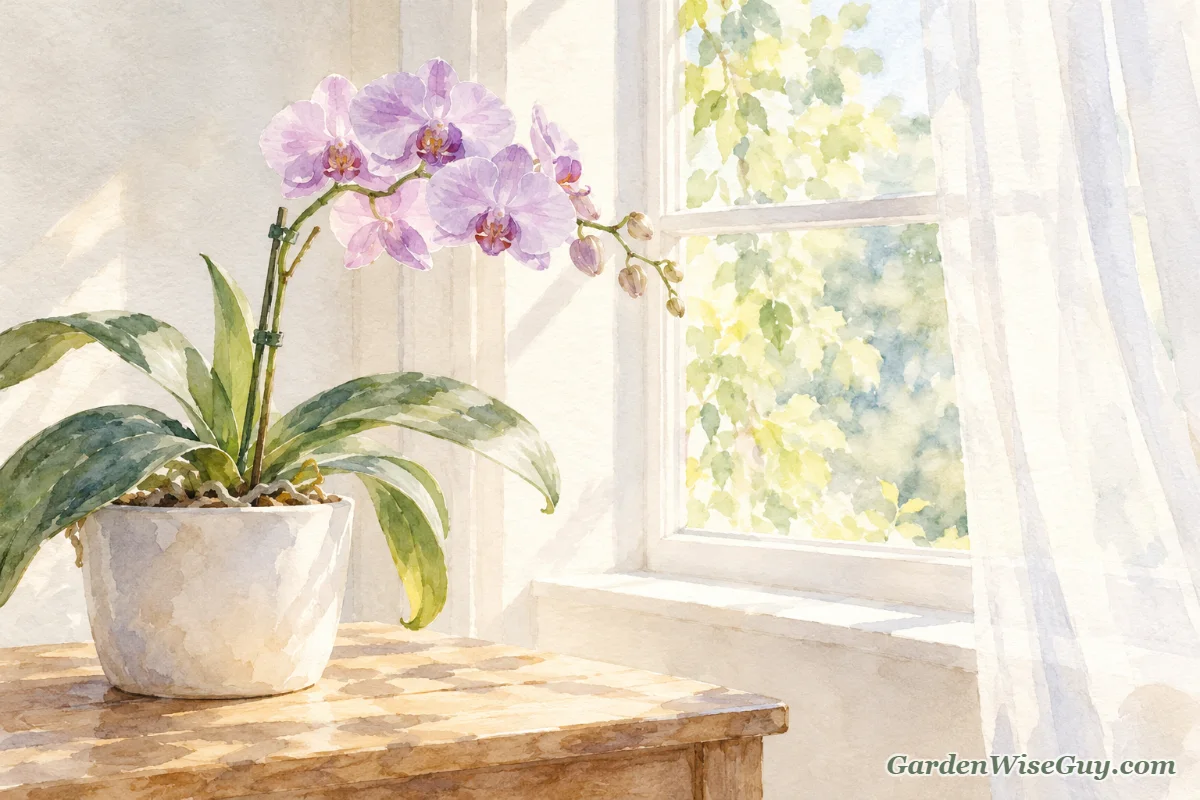
Light needs by orchid type
| Orchid | Light level | Good indoor spot |
|---|---|---|
| Moth orchid (Phalaenopsis) | Low to medium | East window; shaded south or west window |
| Slipper orchid (Paphiopedilum) | Low to medium | East or west window |
| Cattleya | Bright, with some direct sun | South window behind a sheer curtain, or a west window |
| Dendrobium and Oncidium | Bright | South, west or bright east window |
The American Orchid Society puts the upper limit at about 1,500 foot-candles for moth and slipper orchids, about 3,000 for Cattleya, and about 5,000 for Oncidium, Dendrobium and Cymbidium. You don’t need a light meter: the window and how the leaves look tell you most of what you need.
Which window is best?
- East: the safest choice for moth and slipper orchids. Gentle morning sun, no afternoon heat.
- South: the most light. Good for Cattleya and Dendrobium; filter it with a sheer curtain for moth orchids.
- West: bright but hot in the afternoon. Use a sheer curtain in summer.
- North: usually too dim to bloom most orchids.
Keep the plant within about 3 feet of the glass and in front of the window, not off to the side. Light drops quickly with distance: a plant moved from 1 foot to 2 feet from a light source gets roughly a quarter of the light. Keep leaves from touching hot or freezing glass.
Should I rotate my orchid?
Turning the pot now and then keeps leaves growing evenly. Avoid turning it while a flower spike is developing; the buds orient toward the light and can twist if the pot is moved.
Common mistake
Putting an orchid in a “bright room” several feet from the window. It may look bright to you, but the plant gets a fraction of the light it would get on the sill, and it often stops blooming.
Sources
- Principles of Light, American Orchid Society
- Indoor Orchid Care, American Orchid Society
- Phalaenopsis Culture Sheet, American Orchid Society
- Cattleya Culture Sheet, American Orchid Society
- Orchids (HGIC 1560), Clemson Cooperative Extension
- Orchids as Houseplants, Penn State Extension
- Phalaenopsis, NC State Extension