
Look at the leaves and the blooms. Too little light shows as very dark green leaves, thin or floppy new growth and no flowers. Too much shows as pale, yellowish leaves or scorched patches. For most orchids, healthy leaves are a medium, slightly yellow-green.
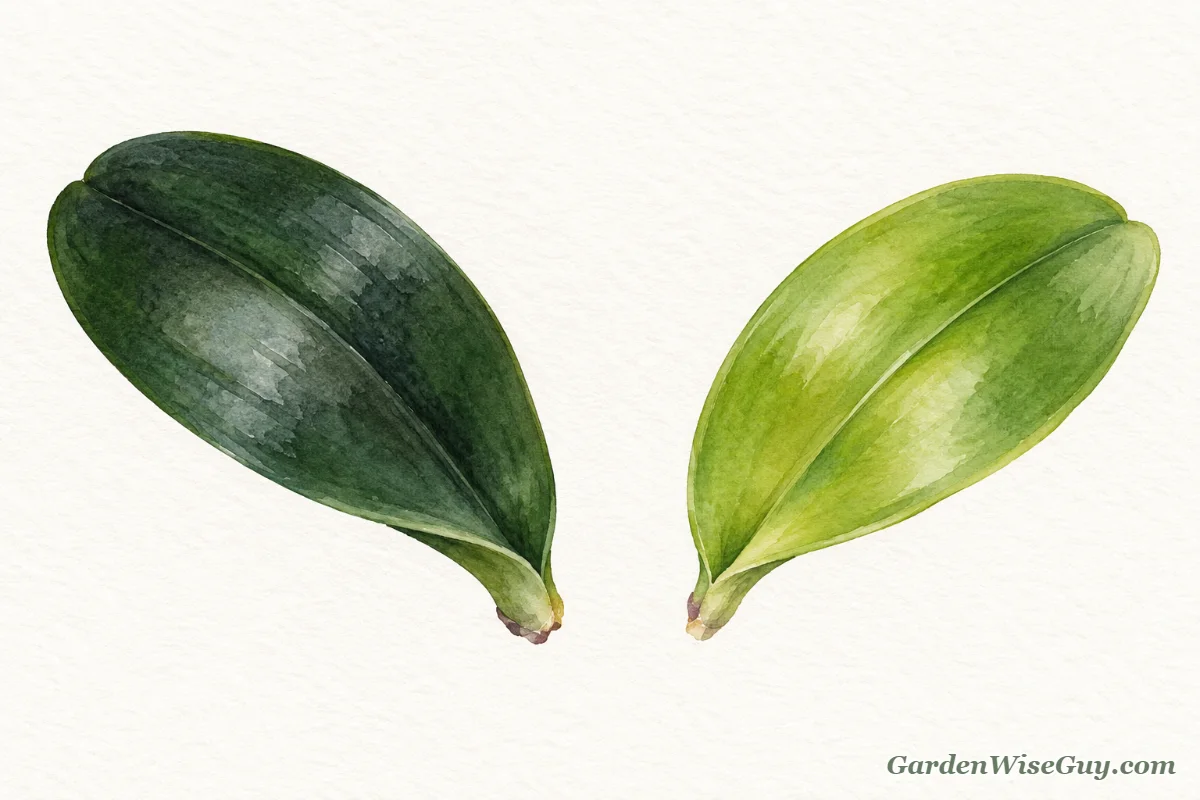
Signs to look for
| What you see | Usually means |
|---|---|
| Very dark green leaves | Too little light (normal for a few types, such as Cattleya, Dendrobium and Catasetum) |
| Thin, narrow or weak new growth | Too little light |
| Healthy-looking plant that won’t bloom | Often too little light |
| Medium green to yellow-green leaves | About right for most orchids |
| A red or purple blush on the leaf edges | Plenty of light, at the upper end of what the plant likes |
| Pale, washed-out yellow leaves | Possibly too much light, though other causes are common |
| Scorched brown or white patches | Too much direct sun |
Why leaf color isn’t the whole story
Yellow leaves also come from root problems, old leaves dying off naturally and other causes. Read leaf color together with the window, the season and how the plant is growing.
What to do
- If leaves are very dark and the plant won’t bloom, move it closer to the window or to a brighter window.
- If leaves are pale or show scorched patches, add a sheer curtain or move it back from the glass.
- Change light gradually. A plant moved straight from a dim spot into strong sun can burn within a day.
Sources
- Principles of Light, American Orchid Society
- Leaf Problems, American Orchid Society
- Cattleya Culture Sheet, American Orchid Society
- Orchids (HGIC 1560), Clemson Cooperative Extension