
Some can live in lower light, but none do well without a window or a grow light. Moth and slipper orchids tolerate the least light of the common houseplant orchids, so they are the best choice for a shaded window. Even they usually stop blooming when light is too low.
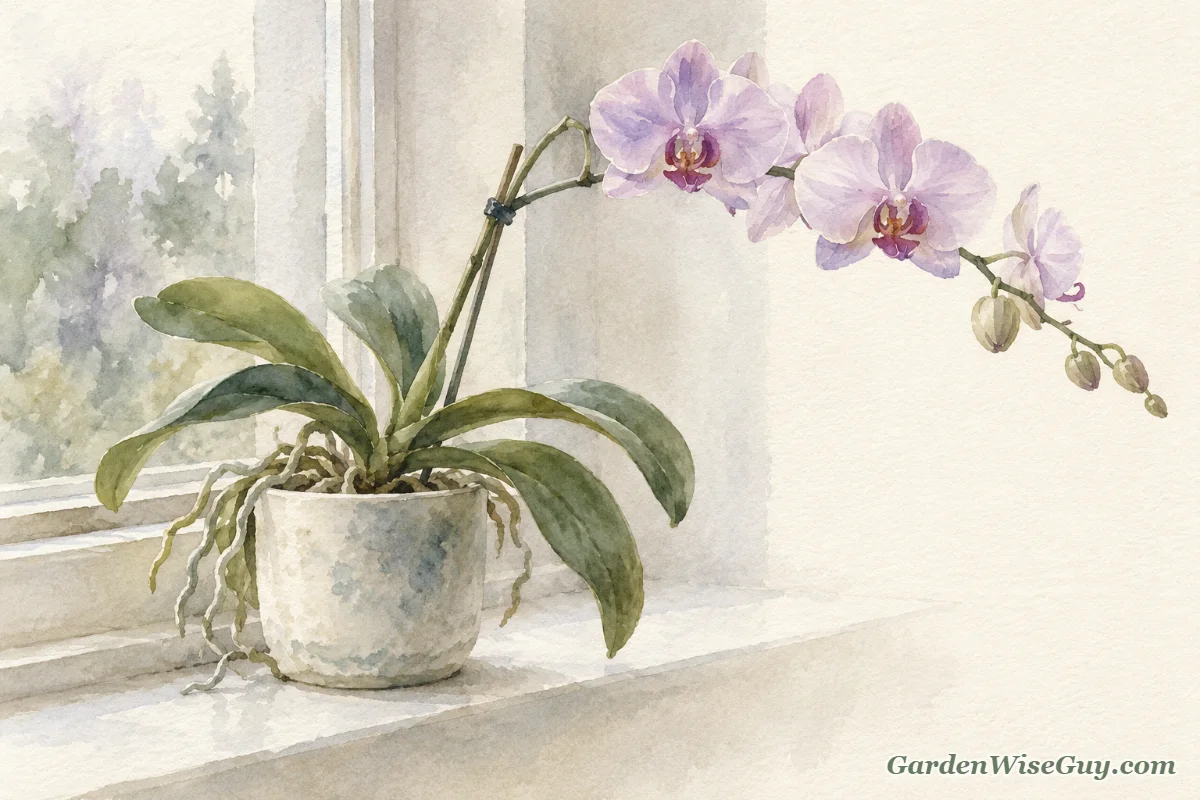
What “low light” means for an orchid
An orchid labeled “low light” still needs a bright window, such as an east window or a shaded south or west window. A north window or a spot across the room is usually too dim to bloom. The American Orchid Society puts it bluntly: there is no such thing as a truly low-light plant.
Offices and fluorescent lights
An office desk under ceiling lights is usually too dim on its own. A moth orchid can work in an office if it sits by a window or has a light fixture close above it. Fluorescent tubes or LEDs 6 to 12 inches above the leaves, run 12 to 16 hours a day, can grow moth orchids with no window at all.
What to do
- Choose a moth or slipper orchid for a dim spot.
- Move it as close to the window as possible.
- Add a small grow light if the plant stops blooming or new leaves come in thin and dark.
Sources
- Indoor Orchid Care, American Orchid Society
- Phalaenopsis Culture Sheet, American Orchid Society
- Orchids (HGIC 1560), Clemson Cooperative Extension
- Orchids as Houseplants, Penn State Extension
- Phalaenopsis, NC State Extension