
Sunburn shows up as a pale yellow or white patch on the part of the leaf facing the sun, which turns brown or black and dries out. It usually appears suddenly, after a plant is moved into stronger sun or sits against hot window glass. Yes, orchids can get too much sun.
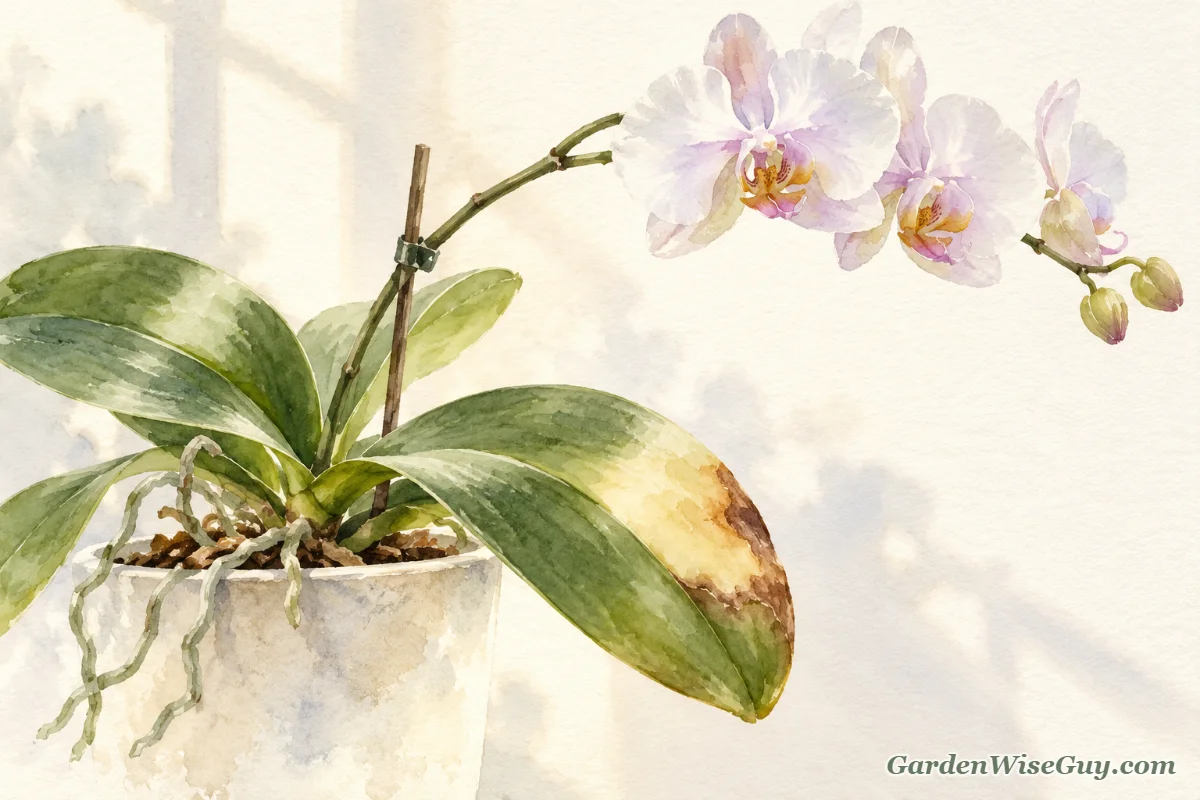
Who gets burned
Moth and slipper orchids scorch most easily; the American Orchid Society notes moth orchid leaves can scorch in direct light above about 1,500 foot-candles. Afternoon sun through a south or west window in summer, or a plant moved outdoors without shade, are the usual causes.
Is it sunburn or something else?
Sunburn appears on the upper, sun-facing side of exposed leaves, often in one patch, and the damaged area is dry. Spots that are wet, spreading or ringed with yellow point to disease instead, and need a different response.
Can an orchid recover from sunburn?
The plant usually recovers; the burned patch doesn’t. Scorched tissue won’t turn green again, but the rest of the leaf keeps working.
- Move the plant out of direct sun right away, or add a sheer curtain.
- Leave the damaged leaf on the plant unless it turns soft or starts to rot. It still feeds the plant.
- Watch the patch for a week or two. If it stays dry it is only cosmetic.
- When moving a plant to brighter light, do it gradually over a couple of weeks.
Common mistake
Moving an orchid from a dim room straight onto a sunny windowsill or outdoors in summer. Leaves grown in low light burn quickly in full sun.
Sources
- Principles of Light, American Orchid Society
- Indoor Orchid Care, American Orchid Society
- Orchids (HGIC 1560), Clemson Cooperative Extension